
Ouch! Passive Tense Flashcards: set 1
vocabulary: broken, cut, eaten, stabbed, punched, kicked, kissed, scratched, killed, pushed, bitten, licked, run over, hit, taken, stung


The MES online flashcard application is an in-browser app that allows full screen display, has audio, and a few vocabulary building games.
Mark's note: I don't do any grammar explanation with these and students can understand pretty clearly without it. I also just start with "He was kicked." or "He was eaten." Once the students get it down pat (a couple weeks to months later depending on the age,) I add "by the flower."
Sets 1 and 2 are backed the same so you can mix and match if you wish.
Worksheets, games, and activities to match the Passive Tense Flash Cards:
Handouts and Worksheets:
MES Games is an online ESL games site for students. There are vocabulary building games, spelling games, grammar games and more. Students can listen to native speakers, answer questions and practice online to help with vocabulary retention and use.
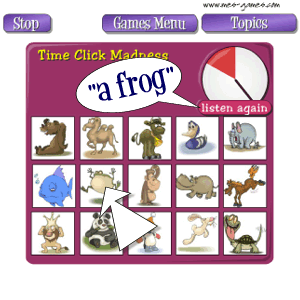
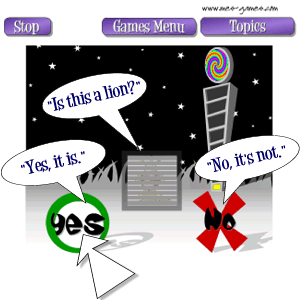
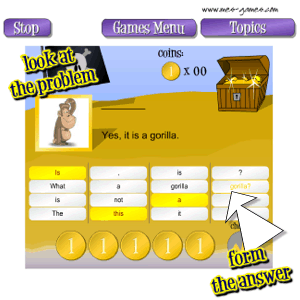
Print old MES files: here are the old (2006~2014) passive tense 1 and 2 files

Ouch! Passive Voice Flashcards: Set 2
vocabulary: stepped on, tackled, knocked over, chased, blown up, smashed, robbed, caught, stolen, burnt, shot, grabbed, pinched, thrown, tripped, ripped up, hugged, knocked down

Passive Tense Games and Ideas:
Passive voice activity: I play a little game where I have three people on one team. They each draw from different piles of cards.
person one: the passive cards
person two: body parts flashcards
person three: animal. insects, people and object flashcards
Each member selects one card from their pile but isn't allowed to show the other members. This works well if you have them facing each other in a circular pattern.
Once they have selected their cards, they them lay them out showing what they chose. Then they need to put those cards together to make a sentence. If the sentence makes sense then they get one point. If it's
nonsense, they don't get a point.
Good: He was bitten on the arm by a snake
Nonsense: He was hugged on the face by a rabbit.
Some of the students will try to reason with you about what makes sense and what doesn't. This is where the real learning and internalization comes in. It's a lot of fun. Prepare for a lot of laughter and chaos management.
You can also let the students draw pictorial representations of any sentence good or no-good for an extra point. That is if you have drawers in the group. Also, you might want to limit the drawing time to one minute, because Pablo will probably want to work too long on his drawing otherwise.
You can have a fourth member and have them use family flashcards for the subject. 'My father was
hit on the leg by a bear."
It's also good to have them rotate positions or card sets to get them to think about different properties of the sentences.
For large classes you can give one card to each of the students and they have to go around and group themselves into sentences that make sense. They can write them down or mark a successful sentence somehow on a piece of paper and then break up to find a new group. Make it an individual competition. The person who has the most marks or sentences is the winner.

MES English Certificate Templates Printable Cards Phonics Worksheets Worksheet Makers ESL Listening
End User License Agreement: You are free to download any resource from this site as an end user and MES-English.com grants you an End User License with the following restrictions: You may not redistribute, copy, modify, transfer, transmit, repackage, charge for or sell any of the materials from this site. You may use photocopies or printouts for distribution to your students. MES reserves the right to terminate or make changes to this agreement for any reason and without notice.
Copyright © 2005 - 2025 MES English | restrictions | privacy | about | contact